How to Meditate at Work Without Anyone Noticing

Sheenam Midha
Writer
April 13, 2026
Do you remember that time at 2:47 PM when your jaw was sore and you knew you were clenching your jaw since lunch? In the case of Slack with 23 unread messages, your inbox is like a crime scene, and your shoulders are around your ears.
It is then that you need to meditate. And it is then that you can not. You may be thinking that meditation had to be done in a quiet room and spend 20 minutes without interruption. It would be more of a setup you would have in a retreat center than a desk in between two colleagues who are fighting over a spreadsheet. Nevertheless, it happens that the most helpful meditation to use to deal with stress at the office does not look anything like what you would imagine. No crossed legs. No closed eyes. No incense. Simply breathing in and out, imitating reading an email.
This is a handbook for doing just that. All of these techniques are rather unseen by the people around you. Your boss will believe that you are concentrating. Your colleagues will not be able to see anything. And you will leave the office feeling a little less frazzled than you used to be.
First, Though: Why Should You Care?
You already know how stressful the work environment can be, there is nothing that I need to explain to you.
According to the survey conducted by the American Psychological Association in 2025, it was revealed that a majority of U.S. workers (54%) reported that job insecurity is currently affecting their stress. In a similar survey in 2024, 61% of workers who reported being psychologically unsafe at work reported being tense or stressed on a typical workday, not in the event of a crisis. And it was an ordinary Tuesday.
Health issues that are caused by stress cost the U.S. businesses between $200 and $300 billion a year in productivity. That’s not a typo.
Why not meditate in workplaces then? Since the conventional wisdom is implausible. Finding a quiet space is not feasible when your space is an open office. Telling yourself to take 20 minutes off is not feasible when your schedule is like a game of Tetris. The following methods omit all that. They occupy the spaces of your day, the spaces that are there.
5 Meditation Techniques That Look Like Normal Work Behavior
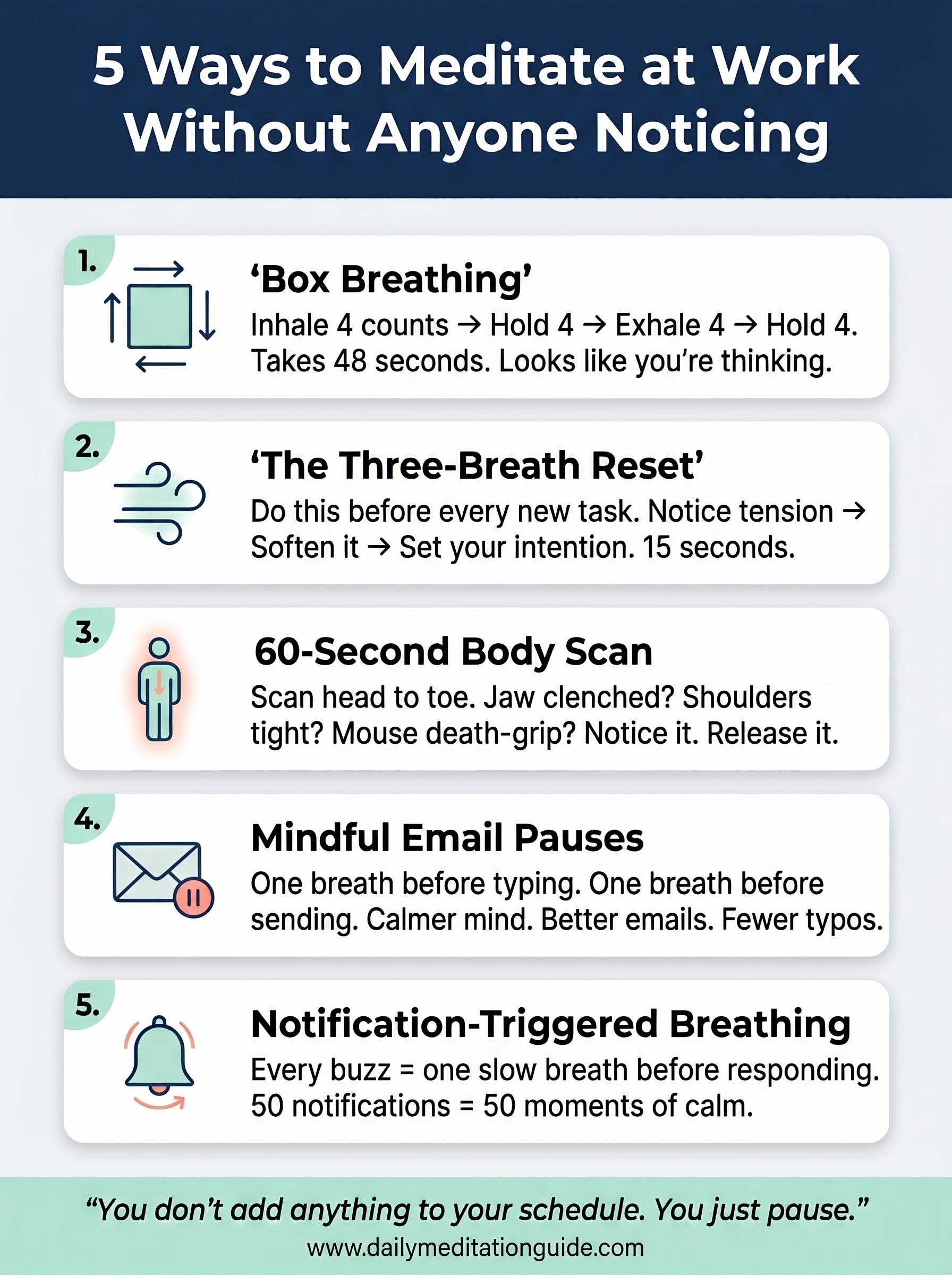
None of these forces you to shut your eyes, put your desk down, and justify yourself to anybody.
1. Box Breathing
This is the type that Navy SEALs employ, and it sounds dramatic, but the method itself is comically easy.
On 4 counts, breathe in through your nose. Hold for 4. Exhale for 4. Hold for 4. That’s one cycle. Do three.
It lasts about 48 seconds. You look as though you were reading something and thinking it over to someone looking at you. On the inside, you are turning on your parasympathetic nervous system, or the part of your body that slows down heart rate and makes your body no longer produce so much cortisol.
I consider this one most effective just before I have a meeting I am dreading or something frustrating in the form of an email. It will not leave the meeting any less boring, but you will be able to enter without the tight chest feeling.
2. The Three-Breath Reset
Get three deep breaths before you begin any new task.
On the first one, you need to note where your body is tight. On the second attempt, be gentle with whatever you observed. On the third, consider for a moment what you are going to do next.
One and a half seconds, one way or another. You are able to do this prior to starting a new email thread, prior to picking up the phone, prior to entering a conference room. It seems nearly too easy to care, but the studies of micro-mindfulness practices indicate that such short breaks accumulate throughout a day at work. You can imagine it as a meditation session, but you would be pressing a soft reset button in between tasks.
3. The 60-Second Body Scan
Body scans can be made conventional, which last 20 to 45 minutes. This version is approximately one minute, or about the same time as your lunch will warm up in the microwave.
Beginning at the top of your head, shift the focus gradually downwards. Are you frowning? Do you have your jaw clenched? Do you have your shoulders hiked up around your ears? Are you holding the mouse, as it may be attempting to flee? Do you have tight stomachs?
You should release the tension when you feel it. Or try to, anyway. At times, it is only necessary to notice it.
You can do this in a conference call when you are on mute or when you are sitting and gazing at your screen between chores. No one can say the difference between sitting at a desk and scanning your body.
4. Mindful Email Pauses
This one is my favorite as it does both things at the same time; it makes you relax, and your emails will be less awful.
Make a single breath before you commence typing a reply. When you are typing, just give a little consideration to the factual sensation of your fingers on the keys. Always give yourself a moment before hitting send, take a breath, and re-read what you have written.
In a 2019 randomized controlled trial at Carnegie Mellon University, a results-based mindfulness training program showed that employees who underwent the training had significantly reduced stress during a real workday as compared to a control group. The researchers had real-time check-ins during the day, not before-and-after surveys; the results are difficult to rule out.
You are likely to receive dozens of emails a day. Both are opportunities to be a bit more mindful. And you will have more typos, a fine bonus.
5. Notification-Triggered Breathing
Whenever your phone buzzes or you get a Slack notification, take a moment and take a single breath before you react.
The entire trick is to do that. Choose an event that happens regularly and regularly during your day (notifications, calendar notifications, anything), and use it as a reminder to take one slow, mindful breath.
When you receive 50 notifications in a day, then that is 50 times you can decide on what you can respond to rather than react. You do not make anything in your schedule. The only thing you do is to put a two-second silence before you participate in what is already taking place. This, in a couple of weeks, begins to alter the relationship you have with interruptions, in general.
What Does the Research Actually Say?
I understand that the idea of trying to breathe differently may seem to be the type of advice you receive on a wellness Instagram page. Here then is what the real science is.
Carnegie Mellon, 2019
This study employed a randomized controlled trial that involved workers in one of the digital marketing companies and divided them into two groups. One received an entire six-week course in mindfulness training. The other received a one-day workshop. The group that experienced the six-week treatment had much lower perceived stress and better coping resistance to mood declines and decreased coping. The interesting aspect of this study is that they not only measured the stress in real time during the workday but also after some weeks.
JAMA Network Open, 2025
In a bigger trial that involved 1,458 employees at a medical center, a digital mindfulness program was compared to a wait-list control. There were positive changes in stress, burnout, depression, and anxiety in the meditation group. Improvements were assessed at a four-month follow-up. Even those who meditated at least five minutes a day had the greatest benefit, a point worth considering since five minutes is not much time in comparison to the typical coffee break.
Headspace Internal Research, 2018
Self-research by Headspace (taken with the correct level of grains since they are researching their product) discovered that ten days of use resulted in a stress reduction of 11%. This increased to 32 after 30 days. Another study in the American Journal of Medicine revealed that nurses who participated in Headspace for a month stated they were more satisfied with their jobs.
Meta-Analysis of 56 Studies, 2020
In the journal Mindfulness, a meta-analysis has been conducted that has combined 56 randomized controlled studies in various workplaces and industries. The uniform conclusion: work-based mindfulness training has lower stress levels, burnout, and overall mental anguish. Their impacts were small to moderate, yet real and manifested themselves in settings that were very dissimilar.
Making It Stick Without Making It a Thing
The trick with these techniques is to know them. It is more difficult to remember to use them when your day goes off track. The following is helpful.
Pick One and Only One
And not all five techniques begin on Monday. Take one of them and practice it for a week, as it sounded the most natural to you. In case box breathing was of interest to you, simply do so. Add later in case you want. The idea is to create something that you will continue doing, not to come up with a wellness routine that collapses by Wednesday.
Attach It to Something You Already Do
It is easier to make habits that are related to a behavior. Breathe three times as your coffee is being brewed. Glance in the mirror and check out your body before opening your email. Eat, walk slowly, and listen when you are going to a meeting. You want to take some breaths before you go to bed at night, just have a mental release of whatever occurred. These do not involve new time commitments. They are simply listening at the expense of the time you are wasting.
Don’t Tell Anyone
There is no need to discuss this with your colleagues and request your supervisor to allow it. When you begin to feel more relaxed and concentrated in the next few weeks, others will see the difference, but be unable to tell why. Let them wonder!
Mistakes That Trip People Up
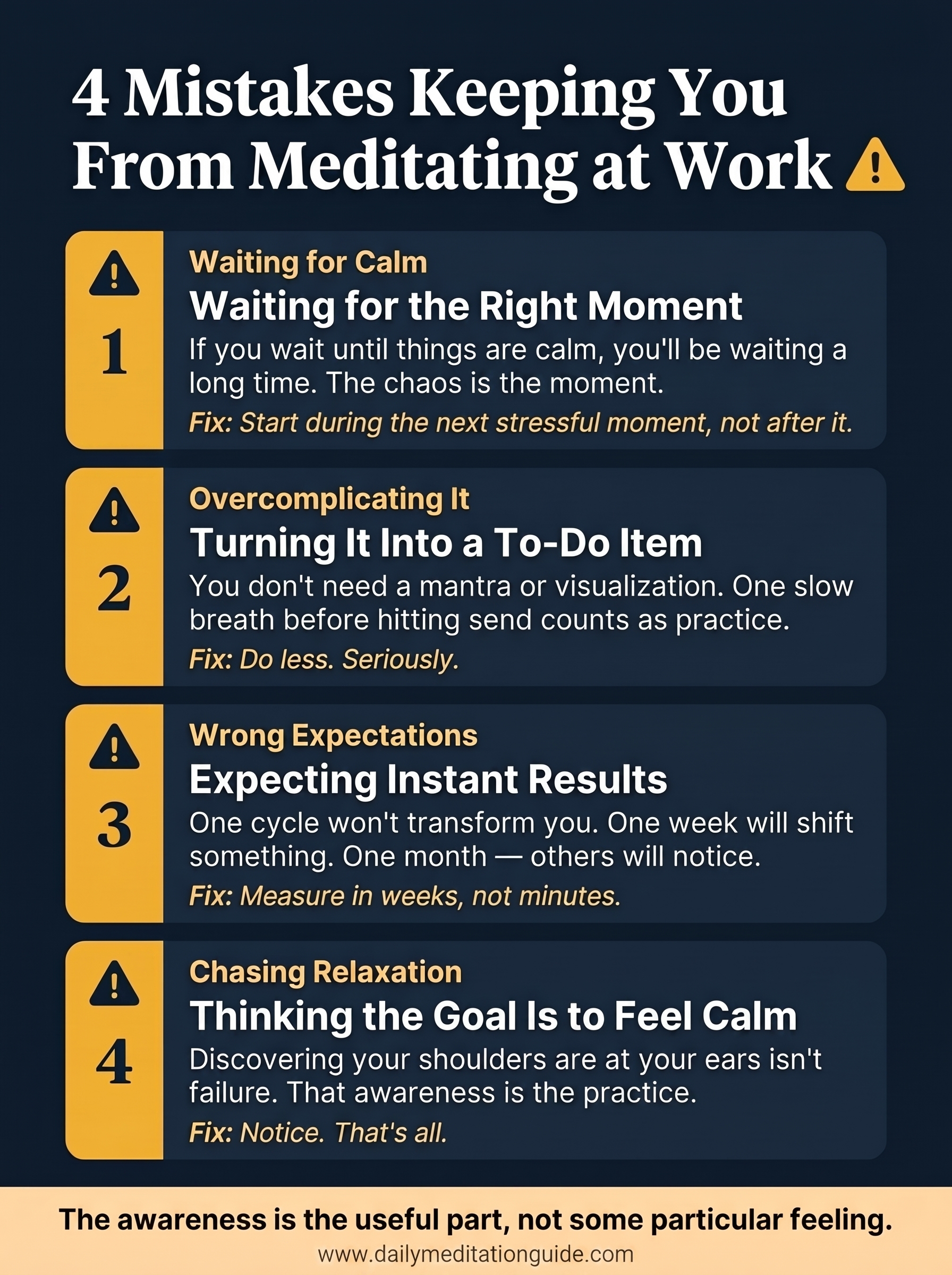
Waiting for a Calm Moment
When you wait till things are quiet to meditate, you will be waiting a long time. These techniques come in handy at the most turbulent times.
Overcomplicating It
One breath counts. You do not require a particular pattern, mantra, or visualization. When you pause a moment and have a deliberate breath before you send out that email, that is enough. Perfectionism will not make this another thing on your list of things to do.
Expecting to Feel Different Immediately
You aren’t likely to notice a big difference after a single box breathing cycle. By practicing it regularly after a week, you’ll find that stressful situations no longer hit the ground in the same manner. After a month, some may say that you look different, and you will not be able to tell why.
Thinking the Goal Is Relaxation
Other times, you will find that your shoulders are virtually touching your ears as a result of doing a body scan. It does not imply that you did anything wrong. It refers to you being unaware of something that you were carrying. It is the means of awareness that is useful and not a certain feeling.
One Last Thing!
It is not those who appear to be relaxed in a situation of pressure who are actually working on some sort of secret lead. They have already discovered a few ways of keeping themselves going. An exhale prior to an appointment. A scan of the body in a boring conference call. A moment of contemplation before making a hot response.
It is all externally unmeditative.
Choose one of the techniques in this list. Try it today. Please continue, if you would. Otherwise, the following day, use another one!
Yes. Many of the traditional meditations are performed with eyes open or dimly angled. You can stare at your computer at your desk. What is going on in your work is in your attention and in your breathing, not in your eyelids.
A real start point is 60 seconds. The studies repeatedly indicate that the practice of desk meditation (one to five minutes) reduces stress levels. Occasional long sessions are not as effective as short sessions that are done frequently.
In one of the studies, the time spent in mind-wandering was decreased by 22% after a single 15-minute session of meditation. One month of practicing daily raised the concentration to 14%. You will work more quickly and have fewer errors when you do not have to walk as much.
In fact, open offices are suitable for this. Box breathing is like thinking. A body scan resembles a sitting pose. Mindful typing is like typing. Externally, there is nothing different.
No. These are not a cure for clinical anxiety, depression, or burnout. In case work-related stress is severely impacting your life, consult with a therapist. Mindfulness in the workplace is an addition, rather than a replacement.
Related Sessions
7 Signs You’re Actually Meditating Correctly
· Focus
Mindfulness vs. Transcendental Meditation: Finding Your Perfect Practice
· Focus
Guided Vs Silent Meditation: Which One Actually Works For You?
· Focus
Morning vs. Night: When is the Best Time to Meditate?
· Sleep
5 Common Meditation Myths That Hold You Back
· Anxiety
The Science of Breathing: How Pranayama Changes the Brain
· Anxiety
10 Mindfulness Exercises for Busy Professionals
· Sleep
Related
7 Signs You’re Actually Meditating Correctly
Mindfulness vs. Transcendental Meditation: Finding Your Perfect Practice
Guided Vs Silent Meditation: Which One Actually Works For You?
Morning vs. Night: When is the Best Time to Meditate?
5 Common Meditation Myths That Hold You Back
The Science of Breathing: How Pranayama Changes the Brain
10 Mindfulness Exercises for Busy Professionals