10 Mindfulness Exercises for Busy Professionals

Sheenam Midha
Writer
April 13, 2026
When you are a busy person working on caffeine and calendar alerts, mindfulness is likely to make its way on your list of things to do someday. Perhaps, then, after that vacation you keep putting off.
What struck me, though, was as follows: in a study carried out on more than 13,000 employees at Aetna, the participants who took part in mindfulness programs claimed that their levels of stress had decreased by 28%, and they had more or less than 62 additional minutes of productivity per week. That will be an hour of your week, less, not more.
Productivity mindfulness is not about cross-legged, floor-humping, hour-long humming. It is all about little, purposeful breaks that can make you think more clearly and get less stressed. And you can do the majority of them at your desk, during a call, or even when you are waiting to have your coffee brewed.
This manual takes you through 10 workouts that are indeed feasible when your timetable is hectic.
Why Mindfulness for Productivity Works (The Science Behind It)
First of all, skepticism. Mindfulness is not merely a wellness craze, but there is scientific evidence.
In Mindfulness (Springer, 2020), a meta-analysis was conducted on 56 randomized controlled trials with more than 5,000 participants. The conclusion: mindfulness-based programs led to a decrease in stress, burnout, and mental distress and an increase in well-being and job satisfaction.
Scholars at Harvard Medical School also discovered that eight weeks of mindfulness training intervention altered the brain areas that were linked with learning and working memory. In regular English, individuals who were mindful remained longer and utilized their time more effectively.
And a meta-analysis by Lomas et al. (2017) of 153 studies (more than 12,000 subjects) revealed an average 30% reduction in psychological stress and 13-22% increase in job satisfaction as a result of mindfulness interventions.
No, it is not wishful thinking. The data is solid.
How Mindfulness Reduces Stress at Work
The main stress in the workplace is normally the feeling that you have too much to do and less control. One of the studies, which was published in the Journal of Organizational Behavior, revealed that mindfulness can make employees less threatened by their tasks. Mindful professionals will find it easier to view tasks as opportunities to be tackled, rather than going down the spiral into I can’t handle this. It is that change of perception rather than workload that reduces stress.
10 Mindfulness Exercises You Can Actually Do at Work
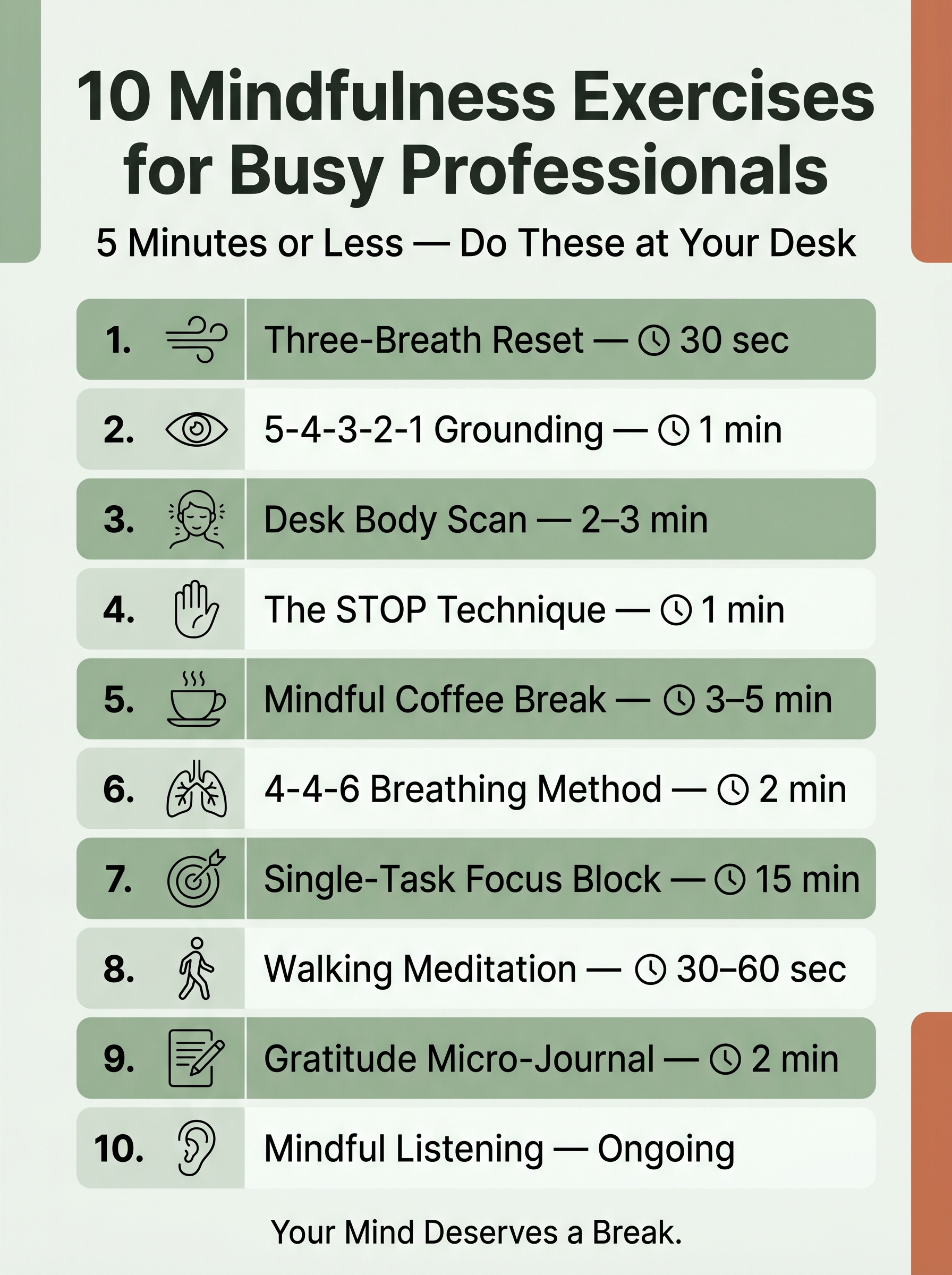
The following are 10 exercises that are suitable for those who are so time-starved that they do not have time to even have lunch, not to mention meditating. All of them last five minutes or so.
1. The Three-Breath Reset
This is nearer to being embarrassingly simple, and it works. In response to a stressful email or a new task, pause to take three deep, slow breaths before beginning work on the task. Breathe in four counts on your nose, two counts in your lungs, six counts out of your mouth.
That’s it. You are resetting your nervous system. Apply it prior to meetings, after phone calls, or at any other time when you realize that your shoulders are slowly creeping up to your ears.
When to apply it: In between meetings, prior to replying to an email that is tense, or following a hard conversation.
2. The 5-4-3-2-1 Grounding Technique
It is an exercise of the senses that takes you out of your mind and into the present. Whatever in this world you do, take note:
• 5 things you can see.
• 4 things that you can touch.
• 3 things that you can hear.
• 2 things you can smell.
• 1 thing you can taste.
It lasts approximately 60 seconds and is surprisingly effective during the times when you become overwhelmed or even anxious. You will not even be detected by anyone around you doing it.
And when to apply it: It should be used in high-stress situations, at any time before a presentation, or when your mind is about to spin.
3. Desk Body Scan
Shut your eyes (or narrow down your eyes in case you are in an open office). Beginning with your feet, gradually work your way up your body. Pay attention to where you are feeling tension, your jaw? Your shoulders? Got your hands stuck to the mouse?
There is nothing to repair. Just notice. Paying attention usually relieves the tension by itself. This is approximately two to three minutes.
When to apply it: Midday doldrums, after extended periods of screen time, or when you are physically stressed.
4. The STOP Technique
It is a guided meditation that can be incorporated at any time in your day:
S - Stop what you’re doing
T - Take a breath
O - Observe your thoughts, feelings, and body sensations
P - Proceed with awareness
It has a formulaic sound, and it is. That’s the point. When you are stressed out, a simple framework will help you not to overthink the exercise itself.
When it is needed: You can use it any time you notice stress accumulating, when you are faced with a major decision, or when switching between tasks.
5. Mindful Coffee (or Tea) Break
You do not have to scroll through your phone and watch your coffee getting colder; instead, you should listen to your beverage. Feel how warm the mug is, smell, taste. Swallow the liquid, and feel it.
This is not making coffee a religious affair. It is about taking some time in your day when you are not multitasking. It re-wires your brain to concentrate on one task at a given time, which is the key muscle of mindfulness to be productive.
When to drink it: In the morning when you are taking your coffee, in the afternoon when you are taking tea, or any drink before or after a meal.
6. The 4-4-6 Breathing Method
This is an improvement upon the three-breath reset. Breathe in 4 times, hold 4 times, breathe out 6 times. Repeat for 2 minutes.
The longer breath puts into play your parasympathetic nervous system - the rest and digest system that overrides the fight-or-flight response. It is the same process that makes sighing a relief.
When to apply it: It can be used in times of high-stakes calls, when someone is frustrated, or it can be a daily routine where one makes 2 calls a day.
7. Single-Task Focus Block
Pick one task. Set a clock for 15 minutes. Until then, do nothing. No email. No Slack. No cell phone quick check.
This is not meditation as we know it, but it is mindfulness, a full focus on what is going on at the moment. The mean worker alternates activities every three minutes. Resisting that desire, even for 15 minutes, will increase your attention capacity as time goes on.
When to apply it: Deep work tasks, creative work, or any type of work that can be done with sustained attention are best done using it.
8. Walking Meditation (Between Meetings)
The next time that you are walking between meetings or between your office and the kitchen, walk a little slower. Feel your feet in contact with the ground. Become aware of your step beat.
You’re not strolling through a Zen garden. You are strolling along a hall. That 30-second mind-space shift may be able to snap the mental chatter that accretes during the day.
Its application: It should be used in between meetings, during breaks, or even when you are heading to get lunch.
9. Gratitude Micro-Journal
This is a practice at the end of your workday, you write three definite things that went well. Not: I am thankful to be healthy- that is too general. Something such as my 2 pm call was better than I thought, or I completed the draft of the report earlier than I thought.
This will take approximately two minutes, and it will reprogram the default position of your brain to no longer scan for threats (what went wrong) to scan for opportunities (what went right). Such a change, over time, enhances mood and decision-making.
When to apply: At the end of the working day, during your traveling (mentally), or before going to sleep.
10. Mindful Listening in Conversations
Next time you meet or have a one-on-one, attempt the following: really listen. Not listening to wait and having your turn to speak. Real listening. You should listen to what the other individual is saying and not plan what to say in your mind.
As soon as you find that your mind is going, bring it back. This is conscientious work habits at work, and it makes your relations better, and your apprehension of things better, and (so often) your own responsiveness better.
When to apply: In all meetings, one-on-one talks, or phone calls.
Quick Reference: Which Exercise to Use When
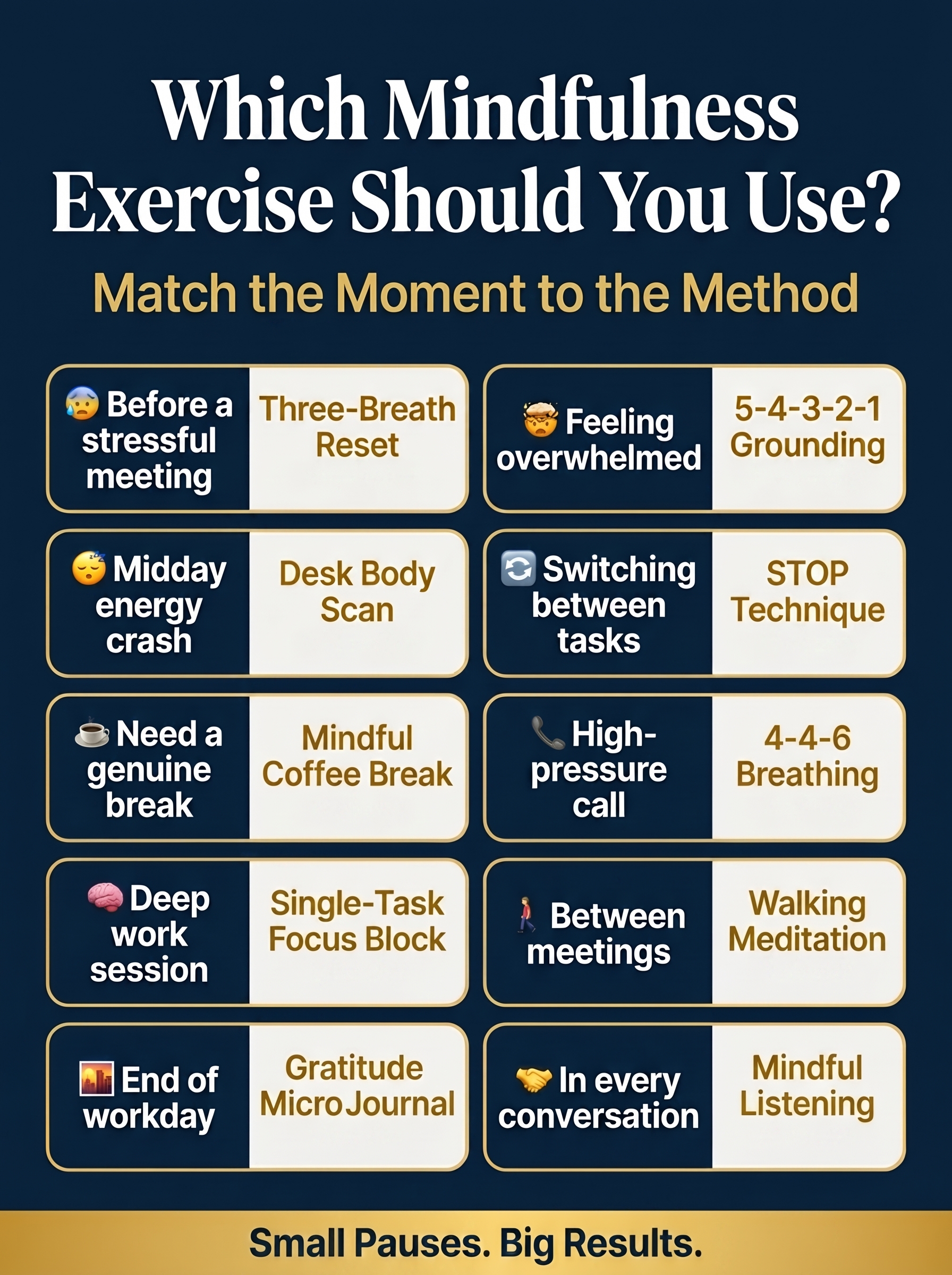
Here’s a practical breakdown to help you pick the right exercise for the moment:
Situation | Best Exercise | Time Needed |
|---|---|---|
Before a stressful meeting | Three-Breath Reset | 30 seconds |
Feeling overwhelmed or anxious | 5-4-3-2-1 Grounding | 1 minute |
Midday energy crash | Desk Body Scan | 2–3 minutes |
Transitioning between tasks | STOP Technique | 1 minute |
Need a genuine break | Mindful Coffee Break | 3–5 minutes |
High-pressure call or presentation | 4-4-6 Breathing | 2 minutes |
Deep work or creative projects | Single-Task Focus Block | 15 minutes |
Walking between meetings | Walking Meditation | 30–60 seconds |
End of the workday | Gratitude Micro-Journal | 2 minutes |
Improving workplace relationships | Mindful Listening | Ongoing |
How to Build a Mindfulness Routine (Without Overhauling Your Schedule)
You need not get up at 5 am or put in another block in your calendar. The following is a pragmatic one:
Start With One Exercise
Select an exercise that is most comfortable from this list. Do it daily, once a week. That’s it. Do not attempt to do the ten. By the end of Day One, most of the people attempting to establish a complete meditation practice were given up by Day Three.
Anchor It to Something You Already Do
Combine your new workout with a habitual one. Three-breath preview prior to your initial meeting. Consider coffee over your morning break. Gratitude Micro-Journal, as your computer shuts down. This habit-stacking technique will help a great deal in sticking to it.
Track Your Experience, Not Your Streak
It is not necessary to get fixated on doing it every day. Rather, observe your mood on the days that you do it and the days that you don’t. Such self-awareness is more motivating than any app streak.
Build Up Gradually
Once a week or two has elapsed using one exercise, introduce a second one. You could have three or four of them constructed into your day in a month, and you could not have altered your schedule at all.
Common Mistakes to Avoid
Some of the common mistakes that people have made regarding workplace mindfulness:
Treating it as another task to check off. When you are working on your breathing exercise and running through your to-do list in your mind, you are just taking additional steps in breathing. The idea is to be there throughout the exercise, though it may be just 30 seconds.
Waiting for the “right” moment. The appropriate time is when you are stressed, distracted, or overwhelmed, which is several times a day for most professionals.
Expecting instant results. Mindfulness is more of an exercise than an aspirin. You will not come out of a session feeling radically different. However, with a couple of weeks of training, you will see that you will respond to stress in a different way. That’s the payoff.
Thinking you need an app or special equipment. You need not have anything. There are those who have been assisted by guided meditation applications, and there is nothing wrong with that. Nonetheless, each of the mentioned exercises does not need any tools, only your mind.
Wrapping Up!
Mindfulness to be productive does not entail an extra burden to your hectic timetable. It is about modifying your way of going through the already existing schedule. Three breathing sessions prior to a conference. Taste your coffee. Hearing the peer and not formulating your reply.
The study confirms it. These practices have actually yielded real and measurable results in companies such as Aetna, Google, and Intel. However, you do not have to have a corporate program to start with. All you have to do is one workout, which you can do once a day, but now.
Choose one of these. Try it tomorrow. See what happens!
Mindfulness trains your brain to concentrate on only a single object at once, which lowers the brain burden of switching tasks. It has been found to reduce burnout and boost job satisfaction, which in turn positively affects the quality and quantity of your output.
The best ones are the 4-4-6 Breathing Method and 5-4-3-2-1 Grounding Technique, which can be performed in less than two minutes right at your desk. Another good alternative is the Three-Breath Reset because it does not need anything but three purposeful inhalations.
Yes - you can do exercises such as the Three-Breath Reset, 5-4-3-2-1 Grounding, and STOP Technique with your eyes open, at your desk, or even on a call. No one will see anything but a momentary pause on your part.
Other benefits, such as feeling relaxed after an exercise in breathing, are instant, though long-term alleviation of stress usually does not appear until two to eight weeks of regular practice. The Aetna study recorded significant stress and productivity improvements after 12 weeks of a program.
Meditation refers to a formal sit-down that involves the breath or a mantra, whereas mindfulness refers to paying attention to the present moment in whatever you are doing. Mindfulness is more convenient in the life of busy workers since you can perform such exercises as Mindful Listening or the STOP Technique during work.
Related Sessions
7 Signs You’re Actually Meditating Correctly
· Focus
Mindfulness vs. Transcendental Meditation: Finding Your Perfect Practice
· Focus
How to Meditate at Work Without Anyone Noticing
· Focus
Guided Vs Silent Meditation: Which One Actually Works For You?
· Focus
Morning vs. Night: When is the Best Time to Meditate?
· Sleep
5 Common Meditation Myths That Hold You Back
· Anxiety
The Science of Breathing: How Pranayama Changes the Brain
· Anxiety
Related
7 Signs You’re Actually Meditating Correctly
Mindfulness vs. Transcendental Meditation: Finding Your Perfect Practice
How to Meditate at Work Without Anyone Noticing
Guided Vs Silent Meditation: Which One Actually Works For You?
Morning vs. Night: When is the Best Time to Meditate?
5 Common Meditation Myths That Hold You Back
The Science of Breathing: How Pranayama Changes the Brain